


The 5-4-3-2-1 strength training method is a classic progression system designed to build maximum strength and power through a gradual increase in load and decrease in reps.
It’s one of the simplest — yet most effective — ways to stimulate adaptation, making it a staple among strength coaches, athletes, and powerlifters.
Let’s break down what it means, how it works, and how modern tools like velocity-based training can help you get the most out of it.
Understanding the 5-4-3-2-1 method
At its core, 5-4-3-2-1 training refers to the number of repetitions performed in consecutive sets — starting with higher reps and lighter loads, and finishing with low reps and heavy loads.
Example structure:
- Set 1 → 5 reps
- Set 2 → 4 reps
Set 3 → 3 reps - Set 4 → 2 reps
- Set 5 → 1 rep
The weight increases with each set, while the reps decrease. This creates a progressive overload effect, preparing your body to handle near-maximal loads safely and efficiently.
The goal of 5-4-3-2-1 strength training
This method targets max strength development — improving the neuromuscular system’s ability to recruit more motor units and generate higher force outputs.
The approach is ideal for:
- Building raw strength in compound lifts (squat, deadlift, bench press).
- Developing power and velocity as intensity increases.
- Teaching athletes how to ramp up to a heavy single without fatigue.
It’s also a great way to build confidence with heavy loads while reinforcing proper technique under pressure.

How to program the 5-4-3-2-1 method
Here’s a sample session structure for a lower-body day using squats:
| Set | Reps | % of 1RM | Rest |
|---|---|---|---|
| 1 | 5 | 70% | 2–3 min |
| 2 | 4 | 75% | 3 min |
| 3 | 3 | 80% | 3–4 min |
| 4 | 2 | 85% | 4 min |
| 5 | 1 | 90–95% | 4–5 min |
Tips for implementation:
- Warm up progressively before starting your first working set.
- Focus on bar speed and control — every rep should be fast and technically sound.
- Rest long enough to maintain quality across all sets.
Why it works
The 5-4-3-2-1 method leverages progressive neural activation — starting with moderate intensity to prime the nervous system, then moving toward heavy, near-maximal efforts.
By reducing reps and increasing load gradually, athletes can reach high intensities without excessive fatigue, unlike traditional 5×5 or 3×8 schemes.
The final single (1 rep) serves as both a performance checkpoint and a stimulus for maximal strength — helping you track progress week to week.

Combining 5-4-3-2-1 with Velocity-Based Training (VBT)
To get the most out of this system, pairing it with velocity-based training adds precision and safety.
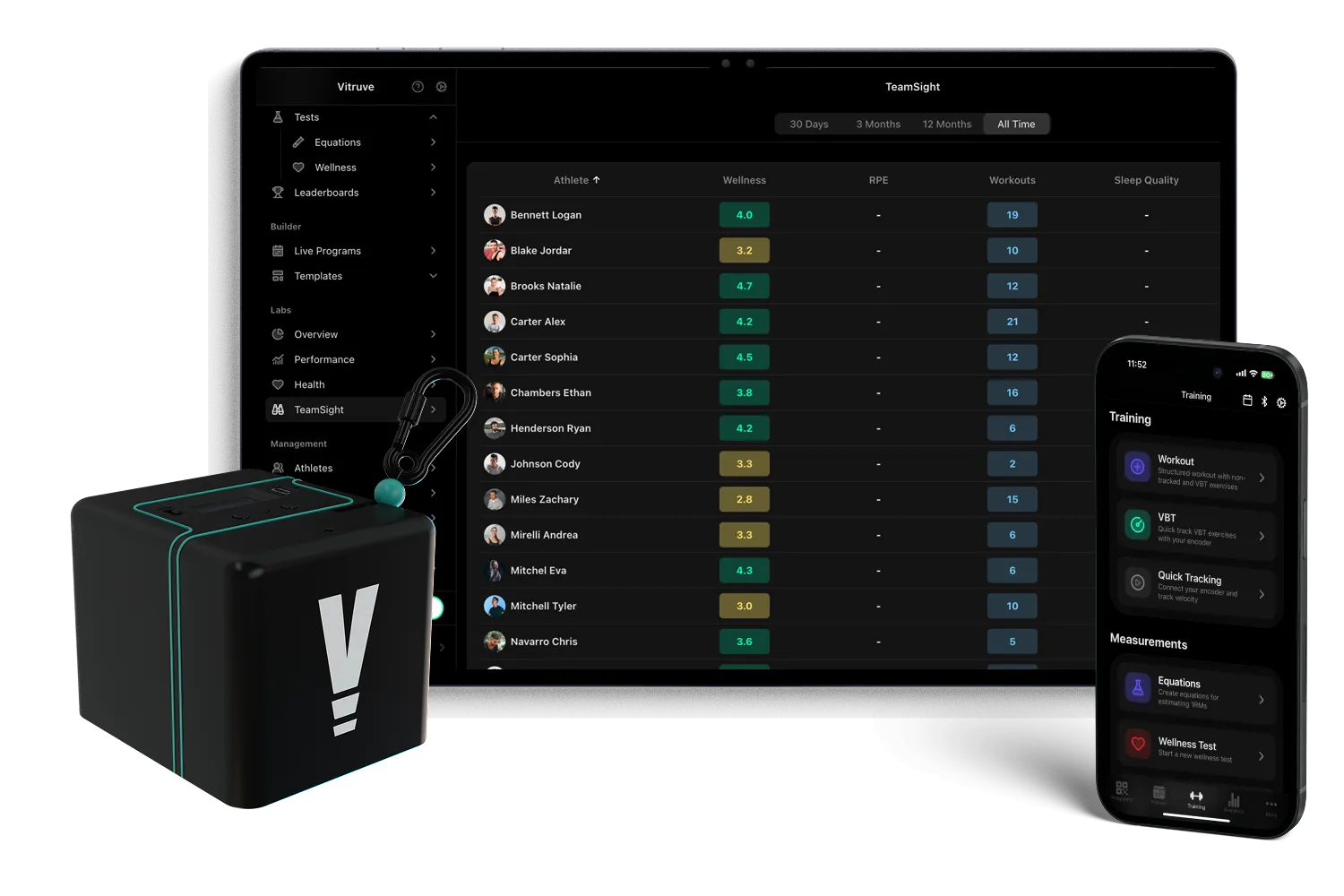
Using tools like the Vitruve Encoder allows you to:
- Track bar speed on every rep to ensure optimal intensity zones.
- Detect neuromuscular fatigue before form breaks down.
- Adjust load in real time to stay within your target velocity zones.
For example, in early sets (5–3 reps), velocity should stay in the strength-speed range (≈0.6–0.8 m/s). As the load gets heavier (2–1 reps), speed naturally drops to the max-strength range (≈0.3–0.5 m/s).
This ensures you’re lifting heavy enough to drive adaptation — but not so heavy that technique or intent suffers.

Integrating it into your program
The 5-4-3-2-1 structure works best as part of a strength block or pre-competition phase. It can be used for main lifts once or twice per week.
To optimize recovery and load management, track your training load metrics — including Chronic Training Load (CTL) and Training Stress Balance (TSB) — through platforms like the Vitruve AMS.
By combining session data (velocity, load, fatigue) with long-term performance trends, coaches can make smarter programming decisions across entire teams.

Final thoughts
The 5-4-3-2-1 strength training method is simple, efficient, and brutally effective. It bridges classic periodization with modern performance analytics — especially when paired with velocity based training and digital tracking tools like Vitruve Encoder and Vitruve Hub.
If your goal is to build real, measurable strength — and track it scientifically — this method delivers both power and precision.
Train smarter, lift faster, and let data guide your next PR.

![Best Velocity Based Training Devices – Full Review [current_year]](https://pre.vitruve.fit/wp-content/uploads/2024/05/Sam2-1.jpg)